The Science Behind the Pull
Blue Mind.
Why water calms the mind, sharpens the senses, and quietly rewires the way we think — and why that matters for every mile of the Blue Rim 5™.
Why water calms the mind, sharpens the senses, and quietly rewires the way we think — and why that matters for every mile of the Blue Rim 5™.
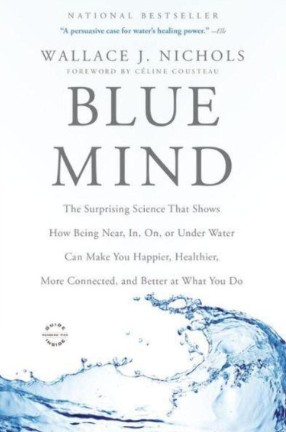
Marine biologist Wallace J. Nichols spent years gathering research from neuroscience, psychology, and medicine to answer a question most of us never bother to ask: why does being near water make us feel better? His book lays out the case that the pull toward oceans, rivers, and lakes isn't sentiment — it's biology. Proximity to water measurably shifts brain activity, lowers stress hormones, and moves the mind into a calmer, more open state he calls Blue Mind — the opposite of the over-stimulated, anxious Red Mind that dominates most modern life on land.
None of this is mystical. It's the nervous system responding to an environment it evolved to recognize as safe, abundant, and worth paying attention to. The sound of waves, the reflection of light on a moving surface, the horizon line where sea meets sky — all of it registers below conscious thought and produces a state that's been measured, not just described.
Cortisol and heart rate fall in the presence of water — the same physiological signature seen in deep rest and meditation, achieved just by being near a coastline or a moving current.
The brain shifts out of hyper-vigilant, task-switching mode and into a slower, more associative pattern — the same state that produces the best ideas in the shower or on a long sail.
With the analytical mind quieted, the brain makes looser, more distant connections — which is why so many writers, scientists, and problem-solvers do their best thinking within sight of water.
Shared water experiences — a boat, a beach, a dock at sunset — consistently produce stronger bonds between people than the same conversation would on land.
Blue Mind isn't a footnote to this expedition — it's a good part of the reason it exists. 1,302 days on a 17-foot catamaran isn't just about the countries or the flags. It's 1,302 days spent inside the exact conditions this research describes: open water, constant horizon, the sound of waves instead of notifications.
Every anchorage, every night watch, every hour spent reading the sky before a squall is time spent in the state Nichols spent his career studying. That's not a bonus feature of this expedition. It's close to the whole point — a decades-long, real-world dataset of one man's mind in continuous contact with the thing that seems to steady it best.